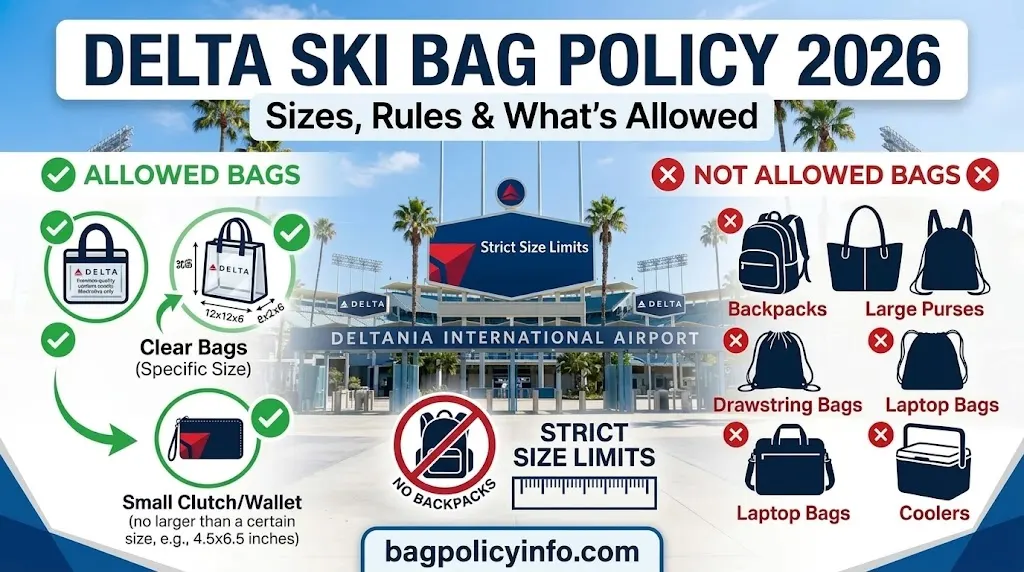
Delta Ski Bag Policy 2026 | Fees, Size Limits & Weight Rules for Skis and Boots
Planning a winter getaway to the slopes with Delta Air Lines? Understanding the official delta ski bag policy before heading to the terminal makes flying with skis on delta seamless and cost-effective. Fortunately for winter sports enthusiasts, traveling with a delta airlines ski bag is far friendlier than most travelers realize: Delta permits you to check one ski or snowboard bag along with one boot bag as a single combined item per passenger. However, keeping your gear under the 50 lb weight threshold and within the generous 115 linear inch limit is critical to avoiding extra charges. Whether you are reviewing the delta snowboard bag policy, calculating potential delta ski bag fee scenarios, or packing your delta ski boot bag, this complete guide covers size restrictions, weight caps, check-in logistics, and pro packing tips to prevent airport surprises.
Quick Answer: Delta Ski Bag Policy Snapshot
Delta accepts ski and snowboard equipment as checked baggage. A ski/pole bag or snowboard bag plus one boot bag is treated as one single item per person, and standard checked baggage fees for your ticketed cabin and travel region apply under the delta ski bag policy.
| Policy Item | Details & Requirements |
|---|---|
| What counts as one item | One ski/pole bag or snowboard bag, plus one boot bag, per person |
| Carry-on or checked? | Checked baggage (oversized/special sporting equipment) |
| Weight threshold | Combined weight over 50 lbs (23 kg) triggers excess weight fees |
| Maximum size | 115 linear inches (292 cm), length + width + height; larger items not accepted |
| Standard fee | Standard checked bag fee based on cabin, route, and number of bags |
| Packing requirement | Durable protective container specifically designed for the equipment |
| Absolute weight cap | Items 100 lbs (45 kg) or more are strictly not accepted |
| Best safe choice | A padded ski or snowboard bag with boots in a separate boot bag, combined under 50 lbs |
| Last verified | October 2, 2026 |
Official Policy Verification & Source Check
Official policy source: Delta Air Lines, “Sporting Equipment” page (Baggage > Special Items), plus the Special Items overview page (delta.com)
Source type: Official airline website
Last checked: October 2, 2026
Confidence level: High for item definition, 50 lb threshold, and 115 linear inch limit; moderate for exact fees, which vary by route, cabin, and Medallion status
Important notes: Delta provides an interactive baggage fee calculator for exact route prices. Baggage rates, premium-cabin weight allowances, and SkyMiles Medallion or co-branded credit card bag waivers change periodically, so confirm your specific booking benefits before travel.
How We Check This Policy: BagPolicyInfo reads the airline’s own sporting equipment and special items pages and treats them as the authoritative source of truth. When a figure appears only on third-party sites, such as a flat dollar rate, we do not present it as Delta policy. Airline regulations can adjust across seasons and international alliances, so always verify directly with Delta before flying.
Official Delta Ski Bag Policy Overview
Delta Air Lines classifies winter sporting gear under special baggage provisions. The core guidelines defining the delta ski bag policy include:
- One person, one item: One ski/pole bag or snowboard bag plus one boot bag is accepted per ticketed traveler as a single checked baggage piece.
- Combined weighing: The ski or snowboard bag and the boot bag are placed on the scales together. If their combined weight exceeds the standard baggage allowance for your cabin (typically 50 lbs / 23 kg in Main Cabin), overweight fees will apply.
- Applicable fees: Standard checked baggage fees based on your booked cabin and geographic travel region apply. If it is your first checked bag, the standard first bag fee applies.
- Size cap: If the exterior linear dimensions (length + width + height) exceed 115 linear inches (292 cm), Delta will not accept the gear.
- Protective packing: All sporting equipment must be properly packed inside a durable, protective bag or hard-shell case designed specifically for the equipment.
Delta’s special items guidance instructs passengers to check in directly with a Delta airport customer service agent at the ticket counter. The agent verifies the dimensions, records the combined weight, and determines whether an overweight or additional checked item fee applies.
What Makes This Delta Policy Different
Compared to other domestic and international carriers, several key nuances make the delta airlines ski bag policy particularly advantageous for skiers and riders:
- Boot bag included as one item: Many airlines treat a separate boot bag as a second checked bag. Delta pairs your ski or snowboard bag and your boot bag together as one single piece, saving you a second bag charge.
- Combined weight calculation: Because both bags are weighed together, packing heavy boots or extra clothing in your boot bag can push an otherwise light ski bag over the 50 lb threshold.
- Generous 115-inch size ceiling: Standard checked luggage is subject to a 62 linear inch maximum before triggering hefty oversize fees. Delta waives standard oversize penalties for ski equipment, permitting up to 115 linear inches (292 cm) without oversize surcharges.
- Absolute hard stops: Bags measuring over 115 linear inches or weighing 100 lbs (45 kg) or more will not be accepted under any circumstances.
- Strict packing standard: Delta strictly requires a durable protective container; loose bundles of skis strapped together with bungees or tape are rejected.
Allowed Bags and Size Limits Under Delta Ski Bag Policy
Review the exact allowances and rules across all gear categories below:
| Equipment Type | Allowance Status | Size & Weight Limits | Packing Guidelines |
|---|---|---|---|
| Ski & Pole Bag | Allowed | Max 115 linear inches | Counts as part of 1 item with boot bag; padded container required. |
| Snowboard Bag | Allowed | Max 115 linear inches | Allowed in place of ski bag; pairs with one boot bag. |
| Ski / Snowboard Boot Bag | Allowed | Weighed with board/ski bag | Contains boots, helmet, goggles; weighed together with gear bag. |
| Combined Bag Set | Allowed | Max 50 lbs combined | Both bags combined count as 1 checked item; standard fee applies. |
| Overweight Gear (51–70 lbs) | Conditional | Subject to excess fee | Excess weight fee assessed if combined weight exceeds 50 lbs. |
| Oversized Gear (> 115 inches) | Prohibited | Exceeds 115 linear inches | Items larger than 115 inches (292 cm) are not accepted. |
| Extreme Weight (≥ 100 lbs) | Prohibited | 100+ lbs (45+ kg) | Strictly barred from passenger baggage. |
Ski Bags
One ski/pole bag is accepted per ticketed passenger. A padded ski sleeve or rolling double ski bag designed to protect your skis and poles is the standard choice. Keep external linear dimensions under 115 inches, particularly when traveling with extended-length powder skis.
Snowboard Bags
Under the delta snowboard bag policy, one snowboard bag is permitted per person in place of a ski/pole bag. The identical 115 linear inch limit and combined weight rules apply.
Boot Bags
One delta ski boot bag is allowed alongside your primary ski or snowboard bag. Ski boots, snowboard boots, helmets, goggles, and winter accessories are typically stored here. Always remember that the weight of this bag directly combines with your gear bag on the airport scale.
Weight Rules
Delta specifies that if the combined weight of the ski/snowboard bag and boot bag exceeds 50 lbs (23 kg) in Main Cabin or Comfort+, applicable overweight baggage fees will be assessed. Travelers booked in Delta One, First Class, or Delta Premium Select receive a 70 lb (32 kg) checked allowance per piece, giving premium flyers substantial leeway.
Family and Group Travel
The one-item definition applies individually to each ticketed passenger. Every family member gets their own ski/snowboard bag and boot bag allowance. Delta’s policy does not permit pooling weight allowances across different travelers on the same PNR, so ensure each individual set stays within the 50 lb boundary.
Prohibited Items and Restrictions for Ski Bags
Delta’s winter sports regulations center on safety, dimensions, and structural integrity. Keep these mandatory boundaries in mind:
- Equipment exceeding 115 linear inches (292 cm) is not accepted under any circumstances.
- Items weighing 100 lbs (45 kg) or more are strictly rejected.
- Skis or boards packed without a durable protective container will be refused.
- Ski and snowboard gear must travel as checked baggage; skis and poles cannot be brought into the aircraft cabin as carry-on luggage.
- Any hazardous goods or battery-operated equipment packed in your ski luggage must fully comply with TSA and Delta hazmat rules. Avalanche rescue packs containing compressed gas cylinders or lithium batteries require advance airline approval and specific handling.
How Check-In Works for Ski Bags
Checking sports equipment on Delta involves a smooth, standardized counter procedure:
- Agent check-in: Proceed to the Delta passenger service counter or dedicated baggage drop. Special sporting gear requires check-in with a uniformed customer service agent.
- Combined weighing: The agent places your ski/snowboard bag and your boot bag on the scale together to calculate total combined weight.
- Dimensional inspection: Staff verifies that the linear length, width, and height remain under 115 inches.
- Tagging and payment: The agent applies baggage tags and collects any standard checked bag fee, overweight fee, or excess piece charge.
- Special handling dispatch: Depending on the airport, your gear is loaded onto an oversized conveyor or personally carted to the oversize TSA screening portal.
Packing Strategy to Avoid Extra Fees
- Weigh together at home: Use a handheld digital luggage scale to weigh both your ski/snowboard bag and boot bag simultaneously, targeting 46–48 lbs to account for scale variance.
- Choose a dedicated padded bag: Invest in a durable, rip-stop nylon or hard-sided case to satisfy Delta’s protective packaging mandate.
- Verify linear dimensions: Calculate Length + Width + Height and ensure the sum is safely below 115 inches.
- Shift dense clothing to your regular suitcase: If your ski gear is close to 50 lbs, pack heavy ski jackets, snow pants, and base layers in your standard luggage.
- Secure bindings and poles: Cushion bindings with bubble wrap or soft accessories to prevent metal gouges during turbulent baggage handling.
- Label every bag thoroughly: Insert ID cards inside and attach robust luggage tags to the exterior of both your gear bag and boot bag.
- Review fare class and cardholder perks: Delta SkyMiles Medallion status and qualifying Delta SkyMiles American Express credit cards provide free first checked bag waivers.
Check-In Anxiety Tips
Flying with expensive, oversized gear can feel intimidating, but preparation eliminates airport tension. Calibrate your bags at home the evening before departure. If you find your gear weighs 53 or 54 lbs, simply remove your ski boots from the boot bag and carry them onto the plane inside a compact backpack as your approved personal item or carry-on bag. Delta gate agents routinely permit ski boots carried onboard, freeing up valuable checked weight.
Day-of Travel Tips From BagPolicyInfo
- Arrive early: Winter hubs like Denver, Salt Lake City, and Bozeman experience heavy ski bag traffic; arrive at least 2.5 hours prior to domestic departure.
- Weigh both pieces together: Keep in mind that a 30-lb ski bag and a 23-lb boot bag will combine to 53 lbs, incurring an overweight penalty.
- Protect your equipment: Use ski straps or padded binding covers to keep skis securely locked together inside the bag.
- Carry on essentials: Keep custom boot footbeds, prescription goggles, and outer ski shells in your carry-on luggage so a baggage delay won’t ruin your first morning on the mountain.
- Photograph packed bags: Take clear photos of your bags and equipment before handing them over to Delta staff for documentation in the unlikely event of damage.
- Know your claim options: If your equipment fails to appear at the oversized luggage carousel, file a claim immediately with the Delta Baggage Service Office before leaving the airport.
Category-Specific Packing Tips
For Skiers
Place skis base-to-base with ski straps securing the tips and tails. Store ski poles with baskets inverted alongside the skis to prevent gouging.
For Snowboarders
Detaching your bindings or collapsing the highbacks flat against the board deck dramatically reduces the exterior profile and prevents binding damage during baggage sorting.
For Families
Label each child’s ski bag and boot bag with matching color-coded ribbons or tags. Keep gear separated by ticketed passenger so each set qualifies under its individual allowance.
For One-Bag Travelers
If you check only your ski bag set and carry on all clothing, your ski bag counts as your first checked piece. On standard domestic Main Cabin fares, this incurs only the baseline first bag fee (often $35).
For International Trips
Transatlantic and transpacific itineraries frequently include complimentary checked baggage in basic allowances. Confirm your ticket’s international baggage rules and note that excess fees may be assessed in local foreign currency.
Before You Go Checklist
- Ski/snowboard bag and boot bag weighed together and verified under 50 lbs
- Total linear dimensions (L + W + H) measured and verified under 115 linear inches
- Gear safely encased inside a durable, padded protective container
- Cabin class and route-specific baggage fee checked via Delta baggage estimator
- Medallion or Delta SkyMiles Amex free bag perks verified
- Visible luggage tags attached to both ski bag and boot bag
- No hazardous goods, loose lithium batteries, or unapproved avalanche cylinders packed
- Extra 45 minutes factored into airport arrival for special counter check-in
- Pre-flight photos taken of packed skis, boots, and luggage
Delta Ski Bag Policy FAQs
Does Delta charge extra for ski bags?
Standard checked baggage fees based on your ticketed cabin and travel region apply under the delta ski bag fee structure. Standard oversize fees are waived up to 115 linear inches, but overweight fees apply if the combined weight exceeds 50 lbs.
Is a boot bag counted as a separate bag?
No. Delta accepts one ski/pole bag or snowboard bag plus one delta ski boot bag per person as a single combined checked item, saving you a second checked bag fee.
What is the weight limit for a Delta ski bag?
The standard weight threshold is 50 lbs (23 kg) combined for both the ski/snowboard bag and the boot bag. Premium cabin passengers may receive up to 70 lbs (32 kg). Items 100 lbs or heavier will not be accepted.
What is the maximum size for a ski bag on Delta?
The maximum size ceiling is 115 linear inches (292 cm), calculated as length + width + height. Any item exceeding 115 linear inches is prohibited from transport.
Can I carry skis on the plane?
No. Skis, snowboards, and ski poles must be checked as baggage due to TSA security regulations and overhead bin size constraints.
Can I check two pairs of skis in one bag?
Delta defines one item as one ski/pole bag or snowboard bag plus one boot bag. While travelers frequently pack two pairs of skis in a double ski bag, the bag must strictly remain under 115 linear inches and 50 lbs combined with your boots.
Do I need a special ski bag?
Yes. Delta requires winter sporting equipment to be packed in a durable protective container specifically designed for that gear. Loose skis bundled with tape or rope are not accepted.
How much does it cost to check skis on Delta?
Delta charges standard checked bag rates, which generally start at $35 for the first checked bag on domestic routes. Use Delta’s online baggage fee calculator for your exact route and fare class.
Do Medallion members or Delta credit card holders get free ski bags?
Yes. Medallion Elite members and eligible Delta SkyMiles American Express cardholders receive complimentary checked bag allowances that apply directly to your ski equipment set.
What if my ski bag is damaged or lost?
Report the issue immediately to the Delta Baggage Service Office near the baggage claim carousel before leaving the airport, and keep your baggage claim tags to file a tracking or reimbursement claim.
Related Bag Policies
Flying with sporting equipment, winter gear, or carry-on luggage on major airlines? Review our comprehensive airline baggage policy guides:
- Southwest Ski Bag Policy Guide
- Southwest Airlines Carry-On Bag Policy Guide
- Frontier Airlines Bag Policy Guide
- Icelandair Bag Policy Guide
- Delta Center Bag Policy Guide
Conclusion
The delta ski bag policy is among the most generous in commercial aviation: one ski or snowboard bag plus one boot bag counts as a single checked piece, charged at standard baggage rates. Keep your combined weight under 50 lbs, stay beneath the 115 linear inch limit, and pack your gear inside a robust protective case. By weighing and measuring your setup before heading to the terminal, you can enjoy a smooth journey straight from the airport to the ski slopes.
Airline baggage fees, weight allowances, and sporting equipment rules can adjust across routes and code-share partners. Always confirm the latest guidelines on Delta Air Lines’ official website before departure. BagPolicyInfo.com is an independent travel resource and is not affiliated with Delta Air Lines.
One Comment