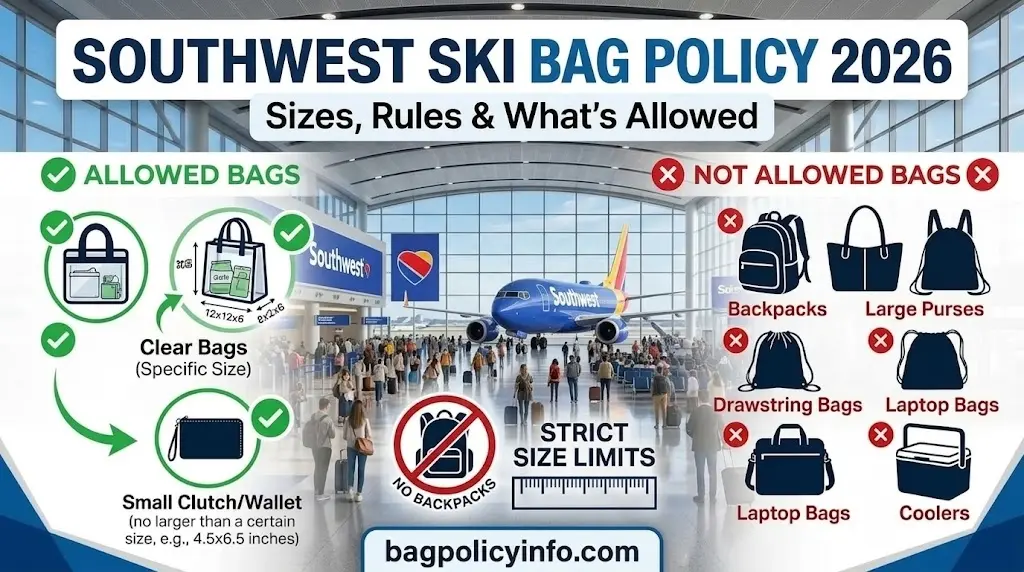
Southwest Ski Bag Policy 2026 | Weight Limits, Fees & What Counts as One Item
Flying Southwest to the mountains for ski season? Understanding the official southwest ski bag policy can save you significant time, money, and hassle at the check-in desk. Unlike many carriers that calculate weight on a combined basis, checking a southwest airlines ski bag features two distinct advantages: up to two bags of snow ski gear count as a single checked item even when packed and tagged separately, and standard oversize fees are completely waived. However, each bag must strictly comply with the 50 lb weight limit, remain under the 115 linear inch maximum, and adhere to Southwest’s equipment guidelines. Whether you are reviewing the southwest snowboard bag policy, organizing your southwest ski boot bag, comparing southwest ski equipment fees, or preparing for flying with skis on southwest, this complete guide breaks down the rules, check-in logistics, and packing strategies so you pay only what you have to.
Quick Answer: Southwest Ski Bag Policy Snapshot
Southwest accepts snow ski equipment as checked baggage. Up to two bags holding one set of skis or one snowboard, one set of poles, and one pair of boots count as one single item under the southwest ski bag policy.
| Policy Item | Details & Requirements |
|---|---|
| What counts as one item | Up to two bags: one set of skis or one snowboard, one set of ski poles, one pair of ski/snowboard boots |
| Carry-on or checked? | Checked baggage (oversized/special sporting equipment) |
| Weight per bag | 50 lbs or less per bag to remain exempt from overweight bag fees |
| Maximum size and weight | Over 100 lbs and/or 115 inches total dimensions cannot be checked |
| Oversize fees | Waived (standard oversize surcharges do not apply) |
| Standard fees | Standard checked bag fees and applicable overweight fees apply |
| Plastic bags | Transported only with a limited release of liability |
| Partner airlines | Partner airline baggage guidelines may differ on interline bookings |
| Best safe choice | A padded ski bag and a boot bag, each under 50 lbs, within 115 linear inches |
| Last verified | October 2, 2026 |
Official Policy Verification & Source Check
Official policy source: Southwest Airlines Help Center, “Flying with snow or water ski equipment” (southwest.com)
Source type: Official airline help center
Last checked: October 2, 2026
Confidence level: High for item definition, weight rules, size and weight caps, and oversize fee waiver; the help center links to separate fee schedules for dynamic pricing
Important notes: Southwest directs customers to its separate travel fees page for current checked bag and overweight fee amounts. Because baggage pricing structures evolve, confirm current rates for your fare tier prior to travel.
How We Check This Policy: BagPolicyInfo reads the airline’s own help center and treats it as the authoritative source of truth. When a claim shows up only on third-party sites or travel blogs, we do not present it as Southwest policy. Airline rules can vary, so verify with Southwest before you head to the airport.
Official Southwest Ski Bag Policy Overview
Southwest’s official help center covers snow and water ski equipment comprehensively. For snow sports gear, the core guidelines governing the southwest ski bag policy state:
- Accepted as checked baggage: Skis or snowboards, ski boots, and ski poles are accepted as checked baggage.
- Up to two bags count as one item: One set of snow skis or one snowboard, one set of poles, and one pair of boots, packed in a container or containers acceptable to Southwest, count as one single checked item. This rule applies even when gear is packed and tagged separately.
- 50 lb limit per bag: Each bag must weigh 50 lbs or less individually to avoid an overweight bag surcharge.
- Plastic bags: Equipment packed in a plastic bag is accepted only with a signed limited release of liability.
- Absolute hard limits: Equipment weighing over 100 lbs and/or exceeding 115 inches in total linear dimensions cannot be checked under any circumstances.
- Fee assessment: Standard checked bag fees apply, oversize fees are waived, and overweight fees apply if an individual bag exceeds 50 lbs.
What Makes This Southwest Policy Different
Several distinct advantages set Southwest’s ski gear allowance apart from other commercial carriers:
- Weight is per bag, not combined: Southwest applies the 50 lb threshold to each bag individually. Carriers like Delta weigh the ski bag and boot bag together, where a heavy boot bag can trigger overweight penalties. On Southwest, you get up to 50 lbs in your ski bag AND up to 50 lbs in your boot bag without excess fees!
- Two bags, one item: Splitting skis and boots across two separate bags is explicitly permitted, making it dramatically easier to distribute gear weight safely.
- Oversize fees completely waived: Even extended powder ski bags exceeding standard 62 linear inch boundaries do not trigger oversize penalties, provided they remain under 115 inches.
- Standard baggage rules still apply: The two-bag ski setup counts as one checked bag against your overall ticketed baggage allowance (such as Southwest’s two free checked bags policy on qualifying fares).
- Partner flight variations: If your itinerary involves a codeshare or partner carrier, their equipment rules and fee schedules will take precedence.
Allowed Bags and Size Limits Under Southwest Ski Bag Policy
Review the exact dimensional guidelines and allowances across winter sports equipment:
| Equipment Type | Allowance Status | Size & Weight Limits | Packaging Guidelines |
|---|---|---|---|
| Ski Bag | Allowed | Max 50 lbs / 115 inches | Contains 1 set of skis and poles; counts as 1 item with boot bag. |
| Snowboard Bag | Allowed | Max 50 lbs / 115 inches | Contains 1 snowboard; counts as 1 item with boot bag. |
| Boot Bag | Allowed | Max 50 lbs per bag | Contains 1 pair of ski/snowboard boots; tagged separately. |
| Two-Bag Set | Allowed | Up to 2 bags = 1 item | Each bag up to 50 lbs; counts as one single checked bag. |
| Water Ski Case | Allowed | Max 50 lbs / 115 inches | 1 pair water skis + 1 life vest; hard plastic case required. |
| Plastic Bag Packaging | Conditional | Max 50 lbs | Accepted only with a signed limited release of liability. |
| Extreme Size / Weight | Prohibited | > 100 lbs or > 115 in | Items exceeding limits cannot be checked. |
Ski and Snowboard Bags
One set of snow skis or one snowboard counts toward the one-item allowance under the southwest snowboard bag policy. Gear must be packed inside a durable container acceptable to Southwest, keeping total dimensions within 115 linear inches. A padded, heavy-duty ski bag is the recommended choice.
Boot Bags
One pair of ski or snowboard boots is part of the same one-item allowance. You can pack your boots inside a dedicated southwest ski boot bag, and Southwest will tag both bags under a single baggage allocation.
Ski Poles
One set of ski poles is included in the snow equipment allowance. You can pack poles inside your main ski sleeve or in your boot bag, whichever arrangement best distributes weight under the 50 lb ceiling.
Weight Rules
Each bag must weigh 50 lbs or less to avoid overweight surcharges. If either bag weighs between 51 and 100 lbs, applicable overweight fees will be charged for that specific piece. Items exceeding 100 lbs will not be accepted for transit.
Water Ski Equipment
Southwest’s help center page also covers water ski gear. Pack water skis in a hard plastic case or standard equipment case containing no more than one pair of water skis and one life preserver or vest. The same 50 lb per-bag and 115-inch limits apply.
Prohibited Items and Restrictions for Ski Bags
Southwest’s ski guidance focuses on equipment definitions, container safety, and physical limits. Keep these essential rules in mind:
- Equipment over 100 lbs and/or 115 inches in total linear dimensions cannot be checked.
- Individual bags exceeding 50 lbs incur standard overweight baggage fees.
- Equipment packed in thin plastic bags is transported strictly with a limited release of liability.
- Packing more than the permitted gear per allowance (one pair of skis or one snowboard, one set of poles, one pair of boots) can cause Southwest to charge your luggage as separate, additional baggage items.
- Hazardous items, fuels, loose lithium-ion battery packs, and avalanche safety canisters must strictly adhere to TSA and Southwest hazardous materials guidelines.
How Check-In Works for Ski Bags
Checking your gear with Southwest is streamlined when you follow these counter steps:
- Bag drop check-in: Bring both your ski bag and your boot bag to the Southwest ticket counter or curbside check-in.
- Independent weighing: Southwest agents weigh each bag separately to ensure neither piece exceeds 50 lbs.
- Two-bag tagging: The customer service agent generates two individual luggage tags, linking both pieces together as one checked item.
- Fee assessment: If the gear counts within your free checked allowance, no fee is assessed. Oversize fees are waived automatically. Overweight fees are charged only if a specific bag exceeds 50 lbs.
- Liability check: If you use unpadded plastic wraps, you will be required to sign a limited liability waiver.
Packing Strategy to Avoid Extra Fees
- Weigh each bag independently at home: Ensure your ski bag is under 50 lbs and your boot bag is under 50 lbs.
- Utilize both bags: Take full advantage of the two-bag rule; shift heavy items like ski boots, helmets, and outerwear into the boot bag to keep the ski bag light.
- Invest in padded gear cases: Never use plastic bags or thin trash wraps; heavy-duty padded cases avoid liability waivers and protect expensive edges and bindings.
- Measure total linear dimensions: Add Length + Width + Height to verify the sum stays safely below 115 inches.
- Keep total weight well under 100 lbs: Avoid overpacking accessories into gear bags.
- Label both bags inside and out: Secure durable luggage tags with your phone number and email on both the ski and boot bags.
- Confirm ticket fare benefits: Review Southwest’s current baggage policy for your specific fare class before arriving at the terminal.
Check-In Anxiety Tips
Airport check-in with bulky winter gear can be intimidating. Weigh your bags the night before with a digital scale and write down the numbers. Arrive at the airport early, and keep the official Southwest “Flying with snow or water ski equipment” help page bookmarked on your phone. If a counter agent is unfamiliar with the two-bag, one-item rule, politely show the official policy text to resolve questions instantly.
Day-of Travel Tips From BagPolicyInfo
- Use both bags: Splitting gear across two bags is explicitly approved and provides double the packing flexibility.
- Skip plastic bags: Plastic-wrapped gear travels under limited liability; a durable travel bag guarantees standard airline coverage.
- Save proof of policy: Keep a quick screenshot of Southwest’s ski policy on your mobile device for immediate reference.
- Check your fare rules: Southwest’s baggage allowance may vary based on ticket class or promotion; confirm your exact allowance before traveling.
- Verify partner connections: If flying on an itinerary operated by a partner airline, confirm their specific sporting equipment terms.
- Photograph packed gear: Take detailed photos of your equipment and exterior bags at home to streamline any potential damage or loss claims.
Category-Specific Packing Tips
For Skiers
Pack skis base-to-base and secure tips and tails with Velcro ski straps. Stow your poles between the skis with tips capped to prevent interior fabric tears.
For Snowboarders
Center your board in a padded snowboard sleeve. If packing boots in a separate bag, use the extra space around the board for soft base layers and snow pants.
For Families
Each ticketed skier or snowboarder receives their own two-bag, one-item allowance. Use colored luggage tags to clearly identify which boot bag pairs with each gear bag.
For Travelers Adding Extra Gear
The one-item allowance covers exactly one set of skis/snowboard, one set of poles, and one pair of boots. If packing a second snowboard or additional skis in the same bag, check with Southwest to avoid additional piece fees.
For Water Skiers
Transport water skis in an approved hard-shell equipment case with a maximum of one pair of water skis and one flotation vest.
Before You Go Checklist
- Each bag weighed separately and confirmed at or under 50 lbs
- No more than two bags packed for the single-item allowance
- Total linear dimensions verified under 115 inches
- Total equipment weight confirmed well below the 100 lb ceiling
- Gear safely secured in padded luggage, avoiding plastic bags
- Checked bag fee schedule confirmed for your ticketed fare class
- Partner airline baggage policies reviewed if traveling on an interline flight
- Name tags and contact cards placed inside and attached outside both bags
- Pre-flight photos taken of skis, snowboards, boots, and bindings
- Southwest ski equipment help page saved on your smartphone
Southwest Ski Bag Policy FAQs
Does Southwest charge for ski bags?
Standard checked bag fees and overweight bag fees apply to snow ski equipment under the southwest ski equipment fees schedule. However, oversize baggage fees are waived entirely for approved ski equipment.
How many bags count as one item?
Up to two bags containing one set of skis or one snowboard, one set of poles, and one pair of boots count as one single item, even when packed and tagged separately under the southwest ski bag policy.
What is the weight limit for a ski bag on Southwest?
Each bag must weigh 50 lbs or less individually to avoid an overweight bag fee. Equipment weighing over 100 lbs cannot be checked.
What is the maximum size for ski equipment on Southwest?
Equipment exceeding 115 inches in total linear dimensions (length + width + height) cannot be checked.
Are oversize fees charged for long ski bags?
No. Southwest’s official policy explicitly waives oversize bag fees for snow and water ski equipment within 115 linear inches.
Can I put my boots in a separate bag?
Yes. Carrying boots in a separate southwest ski boot bag is explicitly permitted and both pieces will be tagged together as one item.
Can I use a plastic bag for my skis?
Southwest will accept gear in a plastic bag only under a signed limited release of liability. A proper padded travel bag is strongly recommended.
Can I carry skis on the plane?
No. Due to security regulations and aircraft overhead bin limitations, snow ski and snowboard equipment must be transported as checked baggage.
Does the policy apply to partner airlines?
Not necessarily. When your travel itinerary includes flights operated by partner carriers, that specific partner’s baggage rules will apply.
How much does it cost to check skis on Southwest?
Southwest charges standard checked bag rates based on your fare class and checked bag count. If the item qualifies within your fare’s free checked allowance, it flies free.
Related Bag Policies
Planning your next ski trip or flying with winter sporting equipment on commercial carriers? Explore our dedicated travel and airline baggage guides:
- Delta Ski Bag Policy Guide
- Southwest Airlines Carry-On Bag Policy Guide
- Frontier Airlines Bag Policy Guide
- Icelandair Bag Policy Guide
- Carnival Cruise Bag Policy Guide
Conclusion
The southwest ski bag policy offers unmatched value for winter athletes: up to two bags holding one set of skis or a snowboard, poles, and boots count as a single item, each bag enjoys a 50 lb allowance, and oversize fees are waived up to 115 linear inches. By distributing gear across two padded bags, weighing each bag before departure, and confirming your fare benefits, you can set off for the snowfields with complete confidence.
Airline baggage rules, fare allowances, and equipment fee structures can change periodically. Always verify the latest information on Southwest Airlines’ official website before your trip. BagPolicyInfo.com is an independent guide and is not affiliated with Southwest Airlines.
One Comment